The Ethics of Public Shaming
and Freedom of Speech in Russia
and USA
and Freedom of Speech in Russia
and USA
created by Kotleva Maria, Rakova Polina, Gutsliuk Ksenia, Agafonova Ann,
Meteleva Varvara and Myigesh Daria
Meteleva Varvara and Myigesh Daria



The Ethics of Public Shaming
and Freedom of Speech
in Russia and USA
and Freedom of Speech
in Russia and USA
created by Kotleva Maria,
Rakova Polina, Gutsliuk Ksenia, Agafonova Ann, Meteleva Varvara
and Myigesh Daria
Rakova Polina, Gutsliuk Ksenia, Agafonova Ann, Meteleva Varvara
and Myigesh Daria


2
1
3
Why can a careless word on the Internet wipe out an entire career,
and can the support of a crowd instantly turn into public condemnation? Is it really possible to “cancel” a person, and who actually decides whether to forgive or erase someone from public memory?
and can the support of a crowd instantly turn into public condemnation? Is it really possible to “cancel” a person, and who actually decides whether to forgive or erase someone from public memory?
These questions lie at the heart
of the concept of “cancel culture”—
a phenomenon of public condemnation and boycott for actions or statements that contradict social norms. Interestingly,
the term was not coined by any
single author or formalized
in academic works—it emerged spontaneously within online communities and media culture itself, as a reaction
to real events and discussions.
of the concept of “cancel culture”—
a phenomenon of public condemnation and boycott for actions or statements that contradict social norms. Interestingly,
the term was not coined by any
single author or formalized
in academic works—it emerged spontaneously within online communities and media culture itself, as a reaction
to real events and discussions.
So, the idea of cancellation as a social reaction did not appear yesterday.
Its roots go back to practices of public shaming and boycotts that have existed for centuries. But let’s get closer to the point: in 1981, the band Chic released the song “Your Love Is Cancelled,” in which a breakup was compared to the cancellation of a TV show — a metaphor inspired by a personal story and later brought into media culture through the film New Jack City. In that film, screenwriter Barry Michael Cooper used the term “cancel” in reference to a character, which helped spread the word throughout African American vernacular. Later, the term gradually moved into online communities
like Twitter and other social networks
and eventually became a tool
for civic protest.
Its roots go back to practices of public shaming and boycotts that have existed for centuries. But let’s get closer to the point: in 1981, the band Chic released the song “Your Love Is Cancelled,” in which a breakup was compared to the cancellation of a TV show — a metaphor inspired by a personal story and later brought into media culture through the film New Jack City. In that film, screenwriter Barry Michael Cooper used the term “cancel” in reference to a character, which helped spread the word throughout African American vernacular. Later, the term gradually moved into online communities
like Twitter and other social networks
and eventually became a tool
for civic protest.

In this longread, we tried
to cover all aspects
of cancel culture: from
its origins and historical examples to comparisons
of differences between countries and real-life cases. So let’s find out —can someone be truly cancelled, and what consequences might that bring?
to cover all aspects
of cancel culture: from
its origins and historical examples to comparisons
of differences between countries and real-life cases. So let’s find out —can someone be truly cancelled, and what consequences might that bring?
4

Why can a careless word on the Internet wipe out
an entire career, and can the support of a crowd instantly turn into public condemnation? Is it really possible to “cancel” a person, and who actually decides whether to forgive or erase someone
from public memory?
an entire career, and can the support of a crowd instantly turn into public condemnation? Is it really possible to “cancel” a person, and who actually decides whether to forgive or erase someone
from public memory?
These questions lie at the heart of the concept
of “cancel culture”— a phenomenon of public condemnation and boycott for actions or statements that contradict social norms. Interestingly, the term was not coined by any single author or formalized in academic works —
it emerged spontaneously within online communities and media culture itself,
as a reaction to real events and discussions.
of “cancel culture”— a phenomenon of public condemnation and boycott for actions or statements that contradict social norms. Interestingly, the term was not coined by any single author or formalized in academic works —
it emerged spontaneously within online communities and media culture itself,
as a reaction to real events and discussions.
So, the idea of cancellation as a social reaction
did not appear yesterday. Its roots go back
to practices of public shaming and boycotts that have existed for centuries. But let’s get closer
to the point: in 1981, the band Chic released the song “Your Love Is Cancelled,” in which
a breakup was compared to the cancellation
of a TV show — a metaphor inspired by
a personal story and later brought into media culture through the film New Jack City. In that film, screenwriter Barry Michael Cooper used the term “cancel” in reference to a character, which helped spread the word throughout African American vernacular. Later, the term gradually moved into online communities like Twitter and other social networks and eventually became
a tool for civic protest.
did not appear yesterday. Its roots go back
to practices of public shaming and boycotts that have existed for centuries. But let’s get closer
to the point: in 1981, the band Chic released the song “Your Love Is Cancelled,” in which
a breakup was compared to the cancellation
of a TV show — a metaphor inspired by
a personal story and later brought into media culture through the film New Jack City. In that film, screenwriter Barry Michael Cooper used the term “cancel” in reference to a character, which helped spread the word throughout African American vernacular. Later, the term gradually moved into online communities like Twitter and other social networks and eventually became
a tool for civic protest.
In this longread, we tried to cover all aspects of cancel culture: from its origins
and historical examples to comparisons
of differences between countries and real-life cases. So let’s find out — can someone be truly cancelled, and what consequences
might that bring?
and historical examples to comparisons
of differences between countries and real-life cases. So let’s find out — can someone be truly cancelled, and what consequences
might that bring?


Yes, cancel culture is not just a random set of internet reactions – it’s an effective mechanism for social regulation. At the center of this phenomenon is collective morality and social responsibility: the decision to “cancel” is always made by the community,
not by an official authority or by law. Society turns to cancel culture when traditional institutions – courts, police, corporate ethics – prove slow or ineffective. Public condemnation is collective (through social networks, media, professional circles), often spontaneous and emotional, and typically based on a moral assessment of the situation – someone has violated moral expectations, gone against new values, or acted unethically.
not by an official authority or by law. Society turns to cancel culture when traditional institutions – courts, police, corporate ethics – prove slow or ineffective. Public condemnation is collective (through social networks, media, professional circles), often spontaneous and emotional, and typically based on a moral assessment of the situation – someone has violated moral expectations, gone against new values, or acted unethically.
Despite the power of this instrument, it remains outside the sphere of formal law
and depends on the opinions and activity of the crowd. Sometimes collective cancellation helps restore justice where it was previously unavailable, but at other times it leads to toxicity and the destruction of reputations with no chance for a “second try.”
The role of media and social networks here is crucial: they make it possible to instantly mobilize thousands of people, shape the agenda, and even influence judicial
and professional decisions. Essentially, cancel culture is a manifestation of the new media reality, where every user can act as both judge and participant
in the ethical process.
and depends on the opinions and activity of the crowd. Sometimes collective cancellation helps restore justice where it was previously unavailable, but at other times it leads to toxicity and the destruction of reputations with no chance for a “second try.”
The role of media and social networks here is crucial: they make it possible to instantly mobilize thousands of people, shape the agenda, and even influence judicial
and professional decisions. Essentially, cancel culture is a manifestation of the new media reality, where every user can act as both judge and participant
in the ethical process.
The main mechanisms of this kind of social regulation:
01
02
03
Boycott and isolation: society (online and offline)
refuses to support an individual or brand, depriving
them of professional and social opportunities
(for example, loss of employment, contracts,
or audience).
refuses to support an individual or brand, depriving
them of professional and social opportunities
(for example, loss of employment, contracts,
or audience).
Public discussion and shaming: people actively express condemnation, spread information, and fuel waves
of criticism.
of criticism.
Right to rehabilitation: the modern media ethics discussion raises the question, “Can someone shed their ‘cancelled’ status, and what conditions
are necessary for that?”
are necessary for that?”


01
Boycott and isolation: society (online and offline) refuses to support an individual
or brand, depriving them of professional
and social opportunities for example, loss
of employment, contracts, or audience).
or brand, depriving them of professional
and social opportunities for example, loss
of employment, contracts, or audience).
02
Public discussion and shaming: people actively express condemnation, spread information, and fuel waves of criticism.
03
Right to rehabilitation: the modern
media ethics discussion raises the question, “Can someone shed their ‘cancelled’ status,
and what conditions are necessary
for that?”
media ethics discussion raises the question, “Can someone shed their ‘cancelled’ status,
and what conditions are necessary
for that?”

Despite the power of this instrument, it remains outside the sphere of formal law and depends on the opinions
and activity of the crowd. Sometimes collective cancellation helps restore justice where it was previously unavailable, but at other times it leads to toxicity and the destruction of reputations with no chance for a “second try.” The role of media and social networks here is crucial: they make it possible to instantly mobilize thousands of people, shape the agenda, and even influence judicial
and professional decisions. Essentially, cancel culture
is a manifestation of the new media reality, where every user can act as both judge and participant
in the ethical process.
and activity of the crowd. Sometimes collective cancellation helps restore justice where it was previously unavailable, but at other times it leads to toxicity and the destruction of reputations with no chance for a “second try.” The role of media and social networks here is crucial: they make it possible to instantly mobilize thousands of people, shape the agenda, and even influence judicial
and professional decisions. Essentially, cancel culture
is a manifestation of the new media reality, where every user can act as both judge and participant
in the ethical process.


The main mechanisms of this kind of social regulation:
Yes, cancel culture is not just a random set of internet reactions – it’s an effective mechanism for social regulation. At the center of this phenomenon is collective morality and social responsibility: the decision to “cancel” is always made by the community, not by an official authority or by law. Society turns to cancel culture when traditional institutions – courts, police, corporate ethics – prove slow or ineffective. Public condemnation is collective (through social networks, media, professional circles), often spontaneous and emotional, and typically based on a moral assessment of the situation – someone has violated moral expectations, gone against new values, or acted unethically.

Naturally, the phenomenon of "cancel culture" is the subject of active inquiry within academia, particularly in the fields of sociology, ethics, media, and legal studies. Research approaches the issue from diverse perspectives, highlighting both ethical dilemmas and social consequences. This analysis will attempt to delineate the ethical arguments for and against
the "practice of cancelling an individual".
the "practice of cancelling an individual".
A Critical Perspective: Cancel Culture as a Problem for the Public Sphere
Given that cancel culture operates within a media landscape where users
are indirectly connected and lack direct contact, it fosters an erosion of dialogue. From an ethical standpoint, a primary demerit is the suppression of opportunity for discussion, nuance, and forgiveness. Cancel culture frequently reduces complex issues to a binary opposition of "guilty / not guilty," leaving no room
for atonement, education, and the restoration of trust.
Furthermore, the process is characterized by a lack of transparency and due process. The "trial" often occurs outside legal or institutional
frameworks, with accusations adjudicated in the "court
of public opinion" — particularly on social media —
where there are no guarantees of legal defense,
cross-examination, or the presumption
of innocence. This poses significant ethical risks
to the principles of justice.
As cancel culture proliferates, this form of "folk justice"
can evolve into an instrument for suppressing dissent. It can be
weaponized to silence not merely harmful but simply unpopular or dissonant viewpoints. This threatens freedom of speech and intellectual diversity, which
are cornerstones of liberal democracy.
Moreover, the act of cancellation invariably inflicts psychological harm
on its target. It can lead to severe consequences — anxiety, depression,
and a profound sense of social ostracism — which, in some instances,
are disproportionate to the alleged transgression.
Given that cancel culture operates within a media landscape where users
are indirectly connected and lack direct contact, it fosters an erosion of dialogue. From an ethical standpoint, a primary demerit is the suppression of opportunity for discussion, nuance, and forgiveness. Cancel culture frequently reduces complex issues to a binary opposition of "guilty / not guilty," leaving no room
for atonement, education, and the restoration of trust.
Furthermore, the process is characterized by a lack of transparency and due process. The "trial" often occurs outside legal or institutional
frameworks, with accusations adjudicated in the "court
of public opinion" — particularly on social media —
where there are no guarantees of legal defense,
cross-examination, or the presumption
of innocence. This poses significant ethical risks
to the principles of justice.
As cancel culture proliferates, this form of "folk justice"
can evolve into an instrument for suppressing dissent. It can be
weaponized to silence not merely harmful but simply unpopular or dissonant viewpoints. This threatens freedom of speech and intellectual diversity, which
are cornerstones of liberal democracy.
Moreover, the act of cancellation invariably inflicts psychological harm
on its target. It can lead to severe consequences — anxiety, depression,
and a profound sense of social ostracism — which, in some instances,
are disproportionate to the alleged transgression.
From an ethical standpoint, "cancel culture" is a profoundly ambivalent phenomenon. On one hand, it is both a symptom and an instrument of the aspiration for a more equitable society, one in which power is not synonymous with impunity. On the other hand, the methods it employs often contravene fundamental ethical principles, such as procedural justice, proportionality, mercy, and the indispensability of dialogue for a democratic society.
It can be concluded that while public critique and demands for accountability are necessary, mechanisms devoid of nuance, procedural safeguards, and a restorative purpose create significant ethical problems for both the individual and the societal fabric, potentially causing more harm than good
in the long term.
It can be concluded that while public critique and demands for accountability are necessary, mechanisms devoid of nuance, procedural safeguards, and a restorative purpose create significant ethical problems for both the individual and the societal fabric, potentially causing more harm than good
in the long term.

A Defensive Perspective: Cancel Culture as an Instrument of Social Justice
Despite these negative aspects, many researchers and advocates who engage with the mechanisms of cancel culture point to its positive ethical dimensions.
Cancel culture democratizes accountability. Ethically, it can be viewed as a tool through which historically unaccountable groups and marginalized communities can demand answers from powerful individuals and institutions. When traditional justice systems fail, public pressure becomes a recourse of last resort.
It facilitates a shift in the balance of power: cancel culture is a means
for "ordinary" people to collectively challenge harmful narratives and behaviors perpetuated by those with greater platforms and influence. It levels the proverbial playing field, albeit in an imperfect manner.
Additionally, cancel culture serves to establish and reinforce new social norms.
It functions as a mechanism for rapid societal learning and the codification
of more inclusive ethical standards. It sends a clear message that racist, sexist, and homophobic speech and actions are socially unacceptable
and will incur consequences.
Perhaps the most unconventional positive effect attributed to cancel culture
is its function as an alternative to violence. Proponents argue that it constitutes
a largely non-violent form of social boycott, which is preferable to physical aggression or the silent acceptance of injustice.
Despite these negative aspects, many researchers and advocates who engage with the mechanisms of cancel culture point to its positive ethical dimensions.
Cancel culture democratizes accountability. Ethically, it can be viewed as a tool through which historically unaccountable groups and marginalized communities can demand answers from powerful individuals and institutions. When traditional justice systems fail, public pressure becomes a recourse of last resort.
It facilitates a shift in the balance of power: cancel culture is a means
for "ordinary" people to collectively challenge harmful narratives and behaviors perpetuated by those with greater platforms and influence. It levels the proverbial playing field, albeit in an imperfect manner.
Additionally, cancel culture serves to establish and reinforce new social norms.
It functions as a mechanism for rapid societal learning and the codification
of more inclusive ethical standards. It sends a clear message that racist, sexist, and homophobic speech and actions are socially unacceptable
and will incur consequences.
Perhaps the most unconventional positive effect attributed to cancel culture
is its function as an alternative to violence. Proponents argue that it constitutes
a largely non-violent form of social boycott, which is preferable to physical aggression or the silent acceptance of injustice.
Naturally, the phenomenon of "cancel culture" is the subject
of active inquiry within academia, particularly in the fields
of sociology, ethics, media, and legal studies. Research approaches the issue from diverse perspectives, highlighting both ethical dilemmas and social consequences. This analysis
will attempt to delineate the ethical arguments for and against
the "practice of cancelling an individual".
of active inquiry within academia, particularly in the fields
of sociology, ethics, media, and legal studies. Research approaches the issue from diverse perspectives, highlighting both ethical dilemmas and social consequences. This analysis
will attempt to delineate the ethical arguments for and against
the "practice of cancelling an individual".

A Critical Perspective: Cancel Culture as a Problem
for the Public Sphere
Given that cancel culture operates within a media landscape where users are indirectly connected and lack direct contact, it fosters an erosion of dialogue. From an ethical standpoint, a primary demerit is the suppression of opportunity
for discussion, nuance, and forgiveness. Cancel culture frequently reduces complex issues to a binary opposition
of "guilty / not guilty," leaving no room for atonement, education, and the restoration of trust.
Furthermore, the process is characterized by a lack of transparency and due process. The "trial" often occurs outside legal or institutional frameworks, with accusations adjudicated in the "court of public opinion"
— particularly on social media —
where there are no guarantees of legal
defense, cross-examination, or
the presumption of innocence. This poses
significant ethical risks to the principles
of justice.
As cancel culture proliferates, this form of "folk justice"
can evolve into an instrument for suppressing dissent. It can be weaponized to silence not merely harmful but simply unpopular or dissonant viewpoints. This threatens freedom
of speech and intellectual diversity, which are cornerstones
of liberal democracy.
Moreover, the act of cancellation invariably inflicts psychological harm on its target. It can lead to severe consequences — anxiety, depression, and a profound sense of social ostracism — which, in some instances,
are disproportionate to the alleged transgression.
for the Public Sphere
Given that cancel culture operates within a media landscape where users are indirectly connected and lack direct contact, it fosters an erosion of dialogue. From an ethical standpoint, a primary demerit is the suppression of opportunity
for discussion, nuance, and forgiveness. Cancel culture frequently reduces complex issues to a binary opposition
of "guilty / not guilty," leaving no room for atonement, education, and the restoration of trust.
Furthermore, the process is characterized by a lack of transparency and due process. The "trial" often occurs outside legal or institutional frameworks, with accusations adjudicated in the "court of public opinion"
— particularly on social media —
where there are no guarantees of legal
defense, cross-examination, or
the presumption of innocence. This poses
significant ethical risks to the principles
of justice.
As cancel culture proliferates, this form of "folk justice"
can evolve into an instrument for suppressing dissent. It can be weaponized to silence not merely harmful but simply unpopular or dissonant viewpoints. This threatens freedom
of speech and intellectual diversity, which are cornerstones
of liberal democracy.
Moreover, the act of cancellation invariably inflicts psychological harm on its target. It can lead to severe consequences — anxiety, depression, and a profound sense of social ostracism — which, in some instances,
are disproportionate to the alleged transgression.
A Defensive Perspective: Cancel Culture as an Instrument
of Social Justice
Despite these negative aspects, many researchers and advocates who engage with the mechanisms of cancel culture point
to its positive ethical dimensions.
Cancel culture democratizes accountability. Ethically, it can be viewed as a tool through which historically unaccountable groups and marginalized communities can demand answers from powerful individuals and institutions. When traditional justice systems fail, public pressure becomes a recourse of last resort.
It facilitates a shift in the balance of power: cancel culture
is a means for "ordinary" people to collectively challenge harmful narratives and behaviors perpetuated by those with greater platforms and influence. It levels the proverbial playing field, albeit in an imperfect manner.
Additionally, cancel culture serves to establish and reinforce new social norms. It functions as a mechanism for rapid societal learning and the codification of more inclusive ethical standards. It sends a clear message that racist, sexist, and homophobic speech and actions are socially unacceptable
and will incur consequences.
Perhaps the most unconventional positive effect attributed
to cancel culture is its function as an alternative to violence. Proponents argue that it constitutes a largely non-violent form
of social boycott, which is preferable to physical aggression
or the silent acceptance of injustice.
of Social Justice
Despite these negative aspects, many researchers and advocates who engage with the mechanisms of cancel culture point
to its positive ethical dimensions.
Cancel culture democratizes accountability. Ethically, it can be viewed as a tool through which historically unaccountable groups and marginalized communities can demand answers from powerful individuals and institutions. When traditional justice systems fail, public pressure becomes a recourse of last resort.
It facilitates a shift in the balance of power: cancel culture
is a means for "ordinary" people to collectively challenge harmful narratives and behaviors perpetuated by those with greater platforms and influence. It levels the proverbial playing field, albeit in an imperfect manner.
Additionally, cancel culture serves to establish and reinforce new social norms. It functions as a mechanism for rapid societal learning and the codification of more inclusive ethical standards. It sends a clear message that racist, sexist, and homophobic speech and actions are socially unacceptable
and will incur consequences.
Perhaps the most unconventional positive effect attributed
to cancel culture is its function as an alternative to violence. Proponents argue that it constitutes a largely non-violent form
of social boycott, which is preferable to physical aggression
or the silent acceptance of injustice.
From an ethical standpoint, "cancel culture" is a profoundly ambivalent phenomenon. On one hand, it is both a symptom and an instrument of the aspiration for a more equitable society, one in which power is not synonymous with impunity. On the other hand, the methods it employs often contravene fundamental ethical principles, such as procedural justice, proportionality, mercy, and the indispensability of dialogue
for a democratic society.
It can be concluded that while public critique and demands for accountability are necessary, mechanisms devoid of nuance, procedural safeguards, and a restorative purpose create significant ethical problems for both the individual and the societal fabric, potentially causing more harm than good
in the long term.
for a democratic society.
It can be concluded that while public critique and demands for accountability are necessary, mechanisms devoid of nuance, procedural safeguards, and a restorative purpose create significant ethical problems for both the individual and the societal fabric, potentially causing more harm than good
in the long term.


TAISIYA KOTELNIKOVA
How would you define "cancel culture"
not as a contemporary media phenomenon, but as a social ritual? What is archaic about it, and what is entirely new?
not as a contemporary media phenomenon, but as a social ritual? What is archaic about it, and what is entirely new?
If we consider society as a collective organism, what function does "cancel culture" perform?
Can one draw an anthropological parallel between "cancellation" and ancient practices of ostracism or tribal exile? What do these practices have
in common, and what is the key distinction
in the digital age?
in common, and what is the key distinction
in the digital age?
Can we consider "cancel culture" a peculiar form
of secular inquisition or a moral trial, where society acts as both judge and executioner?
of secular inquisition or a moral trial, where society acts as both judge and executioner?
What fundamental social needs does an individual satisfy by participating in a "collective cancellation"?
— You see, "cancel culture" is by no means an invention of the internet. It is an ancient social ritual —
a mechanism for enforcing group norms through the exclusion of a transgressor. Our ancestors, when banishing a tribe member who jeopardized the tribe's survival, acted in precisely the same manner; the only difference being that their instrument was not the smartphone. What is entirely new can be distilled into three aspects: scale — ostracism has evolved into
a global tribunal; velocity — the verdict is delivered
not over weeks, but within hours. And, pardon
the comparison, sterility. We "cancel" an individual
with a single click, devoid of any tangible awareness
of the consequences. The anthropologist Mary Douglas, in her seminal work Purity and Danger, brilliantly demonstrated how societies construct the concepts of the pure and the polluted. "Cancellation" is a contemporary ritual of purging
the "social body" of defilement.
a mechanism for enforcing group norms through the exclusion of a transgressor. Our ancestors, when banishing a tribe member who jeopardized the tribe's survival, acted in precisely the same manner; the only difference being that their instrument was not the smartphone. What is entirely new can be distilled into three aspects: scale — ostracism has evolved into
a global tribunal; velocity — the verdict is delivered
not over weeks, but within hours. And, pardon
the comparison, sterility. We "cancel" an individual
with a single click, devoid of any tangible awareness
of the consequences. The anthropologist Mary Douglas, in her seminal work Purity and Danger, brilliantly demonstrated how societies construct the concepts of the pure and the polluted. "Cancellation" is a contemporary ritual of purging
the "social body" of defilement.
— If society is an organism, then "cancel culture" is
an immune response, often an autoimmune one.
Its function is to identify and reject what is perceived
as a threat to the group's integrity and value system.
The problem is that this immune system can malfunction and begin to attack healthy cells. Consider the case
of J.K. Rowling. Her statements were identified
by a segment of society as a threat to the values
of the trans community. A powerful immune response was triggered—a wave of rejection, condemnation,
and an attempt to "expel" the author from her own creative legacy. This is not arbitrary; it is society's
attempt to protect itself.
an immune response, often an autoimmune one.
Its function is to identify and reject what is perceived
as a threat to the group's integrity and value system.
The problem is that this immune system can malfunction and begin to attack healthy cells. Consider the case
of J.K. Rowling. Her statements were identified
by a segment of society as a threat to the values
of the trans community. A powerful immune response was triggered—a wave of rejection, condemnation,
and an attempt to "expel" the author from her own creative legacy. This is not arbitrary; it is society's
attempt to protect itself.
— Most certainly. The commonality is the objective:
to publicly mark and remove norm-violators, thereby reinforcing group solidarity. The classical sociologist
Émile Durkheim termed this "repressive law" — where
the punishment of one serves to unite the many. The key distinction in the digital era is the disappearance
of the reconciliation ritual. In traditional societies, exile could be followed by forgiveness and reintegration.
Digital cancellation culture is often perpetual because
the transgressor's digital footprint remains forever. Furthermore, a misguided statement can now lead
to a form of "social death", a punishment comparable
in its severity to that for a grave crime. This constitutes
a qualitatively new situation.
to publicly mark and remove norm-violators, thereby reinforcing group solidarity. The classical sociologist
Émile Durkheim termed this "repressive law" — where
the punishment of one serves to unite the many. The key distinction in the digital era is the disappearance
of the reconciliation ritual. In traditional societies, exile could be followed by forgiveness and reintegration.
Digital cancellation culture is often perpetual because
the transgressor's digital footprint remains forever. Furthermore, a misguided statement can now lead
to a form of "social death", a punishment comparable
in its severity to that for a grave crime. This constitutes
a qualitatively new situation.
— While the parallel with the Inquisition is tempting,
it is not entirely accurate. The Inquisition was
an institutionalized system with a clear hierarchy
and established procedures. "Cancel culture" is
a horizontal, spontaneous form of folk morality. It has
no supreme judge, verdicts are rendered by the majority.
A more precise analogy would be the Soviet-era assemblies dedicated to denouncing "enemies
of the people." It involves the same collective dynamics, the same euphoria of belonging, and the same fear
of becoming the next victim. It is less a trial and more
a performative act—a drama staging
the triumph of "justice."
it is not entirely accurate. The Inquisition was
an institutionalized system with a clear hierarchy
and established procedures. "Cancel culture" is
a horizontal, spontaneous form of folk morality. It has
no supreme judge, verdicts are rendered by the majority.
A more precise analogy would be the Soviet-era assemblies dedicated to denouncing "enemies
of the people." It involves the same collective dynamics, the same euphoria of belonging, and the same fear
of becoming the next victim. It is less a trial and more
a performative act—a drama staging
the triumph of "justice."
— First, it must be stated that by participating
in cancellation, an individual satisfies profound, often subconscious needs. It is, unequivocally, the need
for belonging and solidarity. Shared indignation is a powerful "social glue." To feel oneself "on the side of good" within
a crowd of like-minded individuals is psychologically comforting. This is what the sociologist Randall Collins termed the "emotional energy" derived from a successful interaction ritual. In a complex, ambivalent world, cancellation offers a stark, black-and-white picture. There
is a guilty party, and their punishment provides a sense
of order triumphing over chaos. And, of course, it is the need for significance and agency. A like, a share, an angry comment affords an ordinary individual the feeling that their voice matters, that they are making history and fighting injustice. In a world where many feel powerless,
this is a potent narrative.
in cancellation, an individual satisfies profound, often subconscious needs. It is, unequivocally, the need
for belonging and solidarity. Shared indignation is a powerful "social glue." To feel oneself "on the side of good" within
a crowd of like-minded individuals is psychologically comforting. This is what the sociologist Randall Collins termed the "emotional energy" derived from a successful interaction ritual. In a complex, ambivalent world, cancellation offers a stark, black-and-white picture. There
is a guilty party, and their punishment provides a sense
of order triumphing over chaos. And, of course, it is the need for significance and agency. A like, a share, an angry comment affords an ordinary individual the feeling that their voice matters, that they are making history and fighting injustice. In a world where many feel powerless,
this is a potent narrative.
anthropologist and sociologist-analyst
at the social research agency "Asis",
a graduate of the RANEPA with a degree
in urban studies. She specializes
in behavioral anthropology in the media.
at the social research agency "Asis",
a graduate of the RANEPA with a degree
in urban studies. She specializes
in behavioral anthropology in the media.


TAISIYA KOTELNIKOVA
anthropologist and sociologist-analyst at the social research agency "Asis", a graduate of the RANEPA with a degree in urban studies. She specializes in behavioral anthropology in the media.
How would you define "cancel culture"
not as a contemporary media phenomenon, but as a social ritual? What is archaic about it, and what is entirely new?
not as a contemporary media phenomenon, but as a social ritual? What is archaic about it, and what is entirely new?
— You see, "cancel culture" is by no means an invention of the internet. It is an ancient social ritual — a mechanism for enforcing group norms through the exclusion of a transgressor. Our ancestors, when banishing a tribe member who jeopardized the tribe's survival, acted in precisely the same manner; the only difference being that their instrument was not the smartphone. What is entirely new can be distilled into three aspects: scale — ostracism has evolved into a global tribunal; velocity — the verdict is delivered not over weeks, but within hours. And, pardon the comparison, sterility. We "cancel" an individual with a single click, devoid of any tangible awareness of the consequences. The anthropologist Mary Douglas, in her seminal work Purity and Danger, brilliantly demonstrated how societies construct the concepts of the pure and the polluted. "Cancellation" is a contemporary ritual of purging the "social body" of defilement.
If we consider society as a collective organism, what function does "cancel culture" perform?
— If society is an organism, then "cancel culture" is an immune response, often an autoimmune one. Its function is to identify and reject what is perceived as a threat to the group's integrity and value system.
The problem is that this immune system can malfunction and begin to attack healthy cells. Consider the case of J.K. Rowling. Her statements were identified
by a segment of society as a threat to the values of the trans community. A powerful immune response was triggered—a wave of rejection, condemnation, and an attempt to "expel" the author from her own creative legacy. This is not arbitrary; it is society's attempt to protect itself.
The problem is that this immune system can malfunction and begin to attack healthy cells. Consider the case of J.K. Rowling. Her statements were identified
by a segment of society as a threat to the values of the trans community. A powerful immune response was triggered—a wave of rejection, condemnation, and an attempt to "expel" the author from her own creative legacy. This is not arbitrary; it is society's attempt to protect itself.
Can one draw an anthropological parallel between "cancellation" and ancient practices of ostracism or tribal exile? What do these practices have in common, and what is the key distinction in the digital age?
— Most certainly. The commonality is the objective to publicly mark and remove norm-violators, thereby reinforcing group solidarity. The classical sociologist Émile Durkheim termed this "repressive law" — where the punishment of one serves to unite the many. The key distinction in the digital era is the disappearance of the reconciliation ritual. In traditional societies, exile could be followed by forgiveness and reintegration. Digital cancellation culture is often perpetual because the transgressor's digital footprint remains forever. Furthermore, a misguided statement can now lead to a form of "social death", a punishment comparable in its severity to that for a grave crime. This constitutes a qualitatively new situation.
Can we consider "cancel culture" a peculiar form of secular inquisition or a moral trial, where society acts as both judge and executioner?
— While the parallel with the Inquisition is tempting, it is not entirely accurate. The Inquisition was an institutionalized system with a clear hierarchy and established procedures. "Cancel culture" is a horizontal, spontaneous form of folk morality. It has no supreme judge, verdicts are rendered by the majority. A more precise analogy would be the Soviet-era assemblies dedicated to denouncing "enemies of the people." It involves the same collective dynamics, the same euphoria of belonging, and the same fear of becoming the next victim. It is less a trial and more a performative act —
a drama staging the triumph of "justice."
a drama staging the triumph of "justice."
What fundamental social needs does an individual satisfy by participating in a "collective cancellation"?
— First, it must be stated that by participating in cancellation, an individual satisfies profound, often subconscious needs. It is, unequivocally, the need for belonging and solidarity. Shared indignation is a powerful "social glue." To feel oneself "on the side of good" within a crowd of like-minded individuals is psychologically comforting. This is what the sociologist Randall Collins termed the "emotional energy" derived from a successful interaction ritual. In a complex, ambivalent world, cancellation offers a stark, black-and-white picture. There is a guilty party, and their punishment provides a sense of order triumphing over chaos. And, of course, it is the need for significance and agency. A like, a share, an angry comment affords an ordinary individual the feeling that their voice matters, that they are making history and fighting injustice. In a world where many feel powerless,
this is a potent narrative.
this is a potent narrative.


When Jon Ronson was attacked on Twitter, it showed how people
in the West control each other as equals (horizontally). In Russia, a similar problem would likely lead to punishment from the government (vertically), using laws about fake news or insulting people's feelings. This difference comes from the different core values of the two societies.
in the West control each other as equals (horizontally). In Russia, a similar problem would likely lead to punishment from the government (vertically), using laws about fake news or insulting people's feelings. This difference comes from the different core values of the two societies.
USA: a society in conflict with itself
Western society is losing its ability to connect different groups of people. Instead, people are sticking only to their own groups ("us vs. them"). The Rules come from liberal ideas about protecting minority groups. In this case ordinary people, on social media, are those who cancel. The goal is to show who is more morally right, and to make someone lose their job or reputation.
The government usually stays out of it or protects free speech.
Even famous writers and thinkers in the West are worried. They say
this is creating a culture where everyone must think the same way.
Western society is losing its ability to connect different groups of people. Instead, people are sticking only to their own groups ("us vs. them"). The Rules come from liberal ideas about protecting minority groups. In this case ordinary people, on social media, are those who cancel. The goal is to show who is more morally right, and to make someone lose their job or reputation.
The government usually stays out of it or protects free speech.
Even famous writers and thinkers in the West are worried. They say
this is creating a culture where everyone must think the same way.
Russia: a tool for government control
In Russia, cancel culture is not something people do to each other. It is mostl
a tool used by the government. The rules come from conservative and patriotic "traditional values." The government and its supporters are those who commit that cancel. Their goal is to silence people who disagree with the government. So, the government is the main force behind the "canceling."
In Russia, cancel culture is not something people do to each other. It is mostl
a tool used by the government. The rules come from conservative and patriotic "traditional values." The government and its supporters are those who commit that cancel. Their goal is to silence people who disagree with the government. So, the government is the main force behind the "canceling."
USA
RUSSIA
who makes the rules? who makes the rules? who makes the rules? who makes the rules? who makes the rules?
who does the cancelling? who does the cancelling? who does the cancelling? who does the cancelling? who does the cancelling?
main goal main goal main goal main goal main goal main goal main goal main goal main goal main goal main goal
what happens? what happens? what happens? what happens? what happenes? what happenes? what happens?
core idea core idea core idea core idea core idea core idea core idea core idea core idea core idea core idea core idea
Liberal ideas
Conservative, government-approved ideas
The public, online
The government
To punish someone
for being "wrong"
for being "wrong"
To stop people from disagreeing with the government
Lose your job
and reputation
and reputation
Face legal problems,
get fired, or be silenced
get fired, or be silenced
"My personal identity
is most important"
is most important"
"The country and its traditions are
most important"
most important"


When Jon Ronson was attacked on Twitter, it showed how people in the West control each other as equals (horizontally). In Russia, a similar problem would likely lead to punishment from the government (vertically), using laws about fake news or insulting people's feelings. This difference comes from the different core values of the two societies.
USA: a society in conflict with itself
Western society is losing its ability to connect different groups of people. Instead, people are sticking only to their own groups ("us vs. them"). The Rules come from liberal ideas about protecting minority groups. In this case ordinary people, on social media, are those who cancel. The goal is to show who is more morally right, and to make someone lose their job or reputation. The government usually stays out of it or protects free speech. Even famous writers and thinkers in the West are worried. They say this is creating a culture where everyone must think the same way.
Western society is losing its ability to connect different groups of people. Instead, people are sticking only to their own groups ("us vs. them"). The Rules come from liberal ideas about protecting minority groups. In this case ordinary people, on social media, are those who cancel. The goal is to show who is more morally right, and to make someone lose their job or reputation. The government usually stays out of it or protects free speech. Even famous writers and thinkers in the West are worried. They say this is creating a culture where everyone must think the same way.
Russia: a tool for government control
In Russia, cancel culture is not something people do to each other. It is mostly a tool used by the government. The rules come from conservative and patriotic "traditional values." The government and its supporters are those who commit that cancel. Their goal is to silence people who disagree with the government. So, the government is the main force behind the "canceling."
In Russia, cancel culture is not something people do to each other. It is mostly a tool used by the government. The rules come from conservative and patriotic "traditional values." The government and its supporters are those who commit that cancel. Their goal is to silence people who disagree with the government. So, the government is the main force behind the "canceling."
RUSSIA
USA
who makes the rules? who makes the rules? who makes the rules? who makes the rules?
Liberal ideas
Conservative, govern-
ment-approved ideas
ment-approved ideas
who does the cancelling? who does the cancelling? who does the cancelling? who does the cancelling?
The public, online
The government
main goal main goal main goal main goal main goal main goal main goal main goal main goal
To punish someone
for being "wrong"
for being "wrong"
To stop people from disagreeing with the government
what happens? what happens? what happens? what happens? what happenes? what happenes?
Face legal problems,
get fired, or be silenced
get fired, or be silenced
Lose your job
and reputation
and reputation
core idea core idea core idea core idea core idea core idea core idea core idea core idea
"My personal identity
is most important"
is most important"
"The country and
its traditions are most important"
its traditions are most important"

RASTYAM T. ALIEV
— The fundamental novelty is linked to the configuration of the media environment and the mode of political mobilization. Digital platforms have radically reduced the transactional costs of coordination and have made morally charged messages algorithmically privileged. This transforms local sanctions of "shame" and "reputational loss" into scalable campaigns. An additional factor is the institutional "privatization of publicness": a significant portion of sanctions is carried out not in the judicial field, but through platform rules and corporate risk management policies (demonetization, deplatforming, contract termination). A political climate of high polarization and identity-based competition imposes a mobilization framework: any dispute is quickly coded as a marker of tribal affiliation, and thus, as a pretext for immediate action. In sum, a hybrid mechanism of extra-legal accountability emerges, operating on "speed" and "probability," where the evidentiary infrastructure follows the event rather than preceding it.
— Two processes are unfolding in parallel. The first is adaptive selfcensorship: actors shift to "low-risk" formulations, thereby narrowing the zone of public experiment. The second is counter-mobilization: an "anti-cancellation" economy emerges, where provocation and demonstrative non-compliance with dominant norms are monetized, and alternative infrastructures (platforms, media, payment systems, communities) minimize external sanction dependency. The macroeffect is what we term the fragmentation of epistemic regimes: different groups register different "basic facts," appeal to non-overlapping moral grammars, and cease to recognize the legitimacy of common arbitration procedures. The risk of long-term schism is real. Potential counterweights are not reducible to a value consensus; these are, first and foremost, institutional solutions: cross-platform moderation standards, the separation of punitive and educational responses, formalized procedures for response and correction, and support for mediation formats (slow interviews, mutual peer reviews, public "position papers"). Only the presence of common procedural and informational infrastructures can reduce the rate of centrifugal disintegration without negating accountability itself.
— In individualistic contexts, "cancellation" is more often articulated as personal accountability and the redistribution of the symbolic capital of a specific author/public figure; practices manifest as public apologies, boycotts, unfollowing, and reputation rebuilding through "pathways of correction." In collectivist cultures, the logic of preserving group "face" and hierarchical order prevails: the sanction may be less theatrical but more deeply institutionalized (exclusion from informal networks, administrative "removal from the agenda" instead of spectacular confrontation). Where power distance is high, the public challenge to authority itself is interpreted as a violation, and "cancellation" practices shift to closed channels: professional associations, party-state structures, corporations. The goals and consequences, accordingly, differ: in liberal-pluralistic fields, the emphasis is on normative signaling ("demonstrating the boundaries of the acceptable through an example"), whereas in hierarchical ones, it is on restoring order and preventing the "proliferation" of a precedent. The methodology of sanction—from public moral spectacle to quiet administrative displacement—reflects precisely these culturalinstitutional matrices.
— Polarization simultaneously increases the visibility of problems and reduces the capacity for their procedural processing. On one hand, ideological competition increases the likelihood that marginalized topics will be articulated and receive attention. On the other hand, the binary framework of "liberation versus censorship" substitutes for the analysis of substance: the distinction between proven harm, value disputes, and professional competence becomes blurred. As a result, the performative, punitive component is strengthened (sanction as a sign of tribal loyalty), while the reparative component is weakened (establishing the damage, proportionality, the right to reply, the possibility of reintegration). A constructive effect arises only where actors acknowledge the multi-level nature of cases and distinguish three planes: (a) empirical harm and its compensation, (b) normative conflict and the frameworks for permissible debate, and (c) platform-corporate sanctions with their procedural guarantees. Without such differentiation, "cancel culture" becomes an indicator of political affiliation rather than a mechanism of public control.
— The attention economy monetization model structurally incentivizes stories with high moral valence and conflict: they predictably increase user retention and are converted into revenue. Algorithmic ranking systems are therefore not neutral: they enhance the "visibility" of precisely those cases where the "harm—guilt— punishment" dramaturgy can be quickly assembled into a clip-like narrative. The editorial practices of news media, oriented towards speed and competition for the agenda, further reinforce the "priority of the story over the investigation." In this architecture, media and platforms effectively combine the roles of initiator of the accusation (selecting the case), architect of the procedure (framing and sequencing publications), and executor of the sanction (de facto deplatforming via platform rules or "reputational offboarding" through corporate partners). This is not reducible to malicious intent; it is a matter of the structure of incentives. Mitigating this bias is possible through institutional "decelerators": verification standards, delaying sanctions until facts are clarified, public appeal mechanisms, transparency in moderation, and outlined "pathways of return" upon meeting rehabilitation conditions.
In your opinion, how have contemporary cultural and political conditions transformed this tool of social regulation into a global and instantaneous phenomenon? What is the fundamental novelty introduced by the digital environment and
the current political climate?
the current political climate?
We observe that "cancel culture" manifests differently in Western and, for example, Eastern societies. Can you provide examples of how collectivist versus individualistic cultural values, and different traditions regarding attitudes toward authority and hierarchy, influence the goals, methods, and consequences
of "cancellation"?
of "cancellation"?
The "spiral of silence" effect and backlash. Are we observing the formation of counter-cultural phenomena where some public figures
or communities intentionally engage in escalation
or create alternative platforms where being "canceled" is impossible? Does this not lead
to an even greater schism in society?
or communities intentionally engage in escalation
or create alternative platforms where being "canceled" is impossible? Does this not lead
to an even greater schism in society?
In public discourse, "cancel culture" has become a powerful ideological weapon. The left often sees it as a tool for social justice and accountability, while the right sees it as a form of censorship and "political correctness." Do you believe this political polarization hinders or helps society in constructively discussing actual transgressions and the boundaries of acceptability?
Mass media and platforms (from Twitter to traditional media) are key actors in the "cancellation" process. In your view, how do the engagement-based business models and algorithms of social networks, as well as the editorial policies of media outlets, shape the narrative around the "canceled" person? Can we say that the media often act as both judge and executioner simultaneously?
1
2
3
4
5

1
In your opinion, how have contemporary cultural and political conditions transformed this tool of social regulation into a global and instantaneous phenomenon? What is the fundamental novelty introduced by the digital environment and
the current political climate?
the current political climate?
invited lecturer, National Research University Higher School of Economics (HSE), St. Petersburg, Department of Media. (engaged in research for the project "The Image of the Other in Digital Culture: Between Reality and Simulation")
— The fundamental novelty is linked to the configuration of the media environment and the mode of political mobilization. Digital platforms have radically reduced the transactional costs of coordination and have made morally charged messages algorithmically privileged. This transforms local sanctions of "shame" and "reputational loss" into scalable campaigns. An additional factor is the institutional "privatization of publicness": a significant portion of sanctions is carried out not in the judicial field, but through platform rules and corporate risk management policies (demonetization, deplatforming, contract termination). A political climate of high polarization and identity-based competition imposes a mobilization framework: any dispute is quickly coded as a marker of tribal affiliation, and thus, as a pretext for immediate action. In sum, a hybrid mechanism of extra-legal accountability emerges, operating on "speed" and "probability," where the evidentiary infrastructure follows the event rather than preceding it.
We observe that "cancel culture" manifests differently in Western and, for example, Eastern societies. Can you provide examples of how collectivist versus individualistic cultural values, and different traditions regarding attitudes toward authority and hierarchy, influence the goals, methods, and consequences
of "cancellation"?
of "cancellation"?
— In individualistic contexts, "cancellation" is more often articulated as personal accountability and the redistribution of the symbolic capital of a specific author/public figure; practices manifest as public apologies, boycotts, unfollowing, and reputation rebuilding through "pathways of correction." In collectivist cultures, the logic of preserving group "face" and hierarchical order prevails: the sanction may be less theatrical but more deeply institutionalized (exclusion from informal networks, administrative "removal from the agenda" instead of spectacular confrontation). Where power distance is high, the public challenge to authority itself is interpreted as a violation, and "cancellation" practices shift to closed channels: professional associations, party-state structures, corporations. The goals and consequences, accordingly, differ: in liberal-pluralistic fields, the emphasis is on normative signaling ("demonstrating the boundaries of the acceptable through an example"), whereas in hierarchical ones, it is on restoring order and preventing the "proliferation" of a precedent. The methodology of sanction—from public moral spectacle to quiet administrative displacement—reflects precisely these culturalinstitutional matrices.

2
In public discourse, "cancel culture" has become a powerful ideological weapon. The left often sees it as a tool for social justice and accountability, while the right sees it as a form of censorship and "political correctness." Do you believe this political polarization hinders or helps society in constructively discussing actual transgressions and the boundaries of acceptability?

3
— Polarization simultaneously increases the visibility of problems and reduces the capacity for their procedural processing. On one hand, ideological competition increases the likelihood that marginalized topics will be articulated and receive attention. On the other hand, the binary framework of "liberation versus censorship" substitutes for the analysis of substance: the distinction between proven harm, value disputes, and professional competence becomes blurred. As a result, the performative, punitive component is strengthened (sanction as a sign of tribal loyalty), while the reparative component is weakened (establishing the damage, proportionality, the right to reply, the possibility of reintegration). A constructive effect arises only where actors acknowledge the multi-level nature of cases and distinguish three planes: (a) empirical harm and its compensation, (b) normative conflict and the frameworks for permissible debate, and (c) platform-corporate sanctions with their procedural guarantees. Without such differentiation, "cancel culture" becomes an indicator of political affiliation rather than a mechanism of public control.
Mass media and platforms (from Twitter to traditional media) are key actors in the "cancellation" process. In your view, how do the engagement-based business models and algorithms of social networks, as well as the editorial policies of media outlets, shape the narrative around the "canceled" person? Can we say that the media often act as both judge and executioner simultaneously?
— The attention economy monetization model structurally incentivizes stories with high moral valence and conflict: they predictably increase user retention and are converted into revenue. Algorithmic ranking systems are therefore not neutral: they enhance the "visibility" of precisely those cases where the "harm—guilt— punishment" dramaturgy can be quickly assembled into a clip-like narrative. The editorial practices of news media, oriented towards speed and competition for the agenda, further reinforce the "priority of the story over the investigation." In this architecture, media and platforms effectively combine the roles of initiator of the accusation (selecting the case), architect of the procedure (framing and sequencing publications), and executor of the sanction (de facto deplatforming via platform rules or "reputational offboarding" through corporate partners). This is not reducible to malicious intent; it is a matter of the structure of incentives. Mitigating this bias is possible through institutional "decelerators": verification standards, delaying sanctions until facts are clarified, public appeal mechanisms, transparency in moderation, and outlined "pathways of return" upon meeting rehabilitation conditions.
4
The "spiral of silence" effect and backlash. Are we observing the formation of counter-cultural phenomena where some public figures or communities intentionally engage in escalation or create alternative platforms where being "canceled" is impossible? Does this not lead to an even greater
schism in society?
schism in society?
— Two processes are unfolding in parallel. The first is adaptive selfcensorship: actors shift to "low-risk" formulations, thereby narrowing the zone of public experiment. The second is counter-mobilization: an "anti-cancellation" economy emerges, where provocation and demonstrative non-compliance with dominant norms are monetized, and alternative infrastructures (platforms, media, payment systems, communities) minimize external sanction dependency. The macroeffect is what we term the fragmentation of epistemic regimes: different groups register different "basic facts," appeal to non-overlapping moral grammars, and cease to recognize the legitimacy of common arbitration procedures. The risk of long-term schism is real. Potential counterweights are not reducible to a value consensus; these are, first and foremost, institutional solutions: cross-platform moderation standards, the separation of punitive and educational responses, formalized procedures for response and correction, and support for mediation formats (slow interviews, mutual peer reviews, public "position papers"). Only the presence of common procedural and informational infrastructures can reduce the rate of centrifugal disintegration without negating accountability itself.
5
RASTYAM T. ALIEV


1
Cancel culture is a law force that comes from society, not a state, which makes this practice twisted and sometimes questionable. To reveal ethical ambiguities that appear with cancel culture, we should study real-life cases and figure out how society tends to cancel people and what can be
the reason for it.
the reason for it.
To simplify our study we can divide all cases in three groups:
People who got cancel-
led reasonably, basically
the most illustrative cases how cancel culture need
to work ideally. That people, suchas Kevin Spacey,
P. Diddy and others, got their deserved punishment motivated by voices
of people, not a lawsuit.
led reasonably, basically
the most illustrative cases how cancel culture need
to work ideally. That people, suchas Kevin Spacey,
P. Diddy and others, got their deserved punishment motivated by voices
of people, not a lawsuit.
GROUP 1
FIRST CASE
People, who logically should get cancelled for their speeches and actions, but for some reason are still active in the media –
these people usually have impressive weight for
the industry and a long-live reputation, which makes
the masses close their eyes on crimes made by a highly respected person.
these people usually have impressive weight for
the industry and a long-live reputation, which makes
the masses close their eyes on crimes made by a highly respected person.
GROUP 3
People who got cancelled because of the duality
of opinions and simply got “under attack” for
no reason. That usually appears when beliefs
of different cultures, religions and governments meet and create a conflict of opinions.
of opinions and simply got “under attack” for
no reason. That usually appears when beliefs
of different cultures, religions and governments meet and create a conflict of opinions.
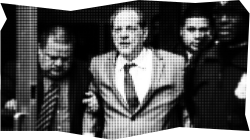
The case of Harvey Weinstein took place in the rise
of cancel culture and became exemplary for it.
In 2017, investigative journalism exposed a decades-long pattern of sexual abuse and harrasment
by Weinstein, who were one of Hollywood's most influential producers at the moment. The sheer weight of accusations, brought forth by many women
from industry, led to Weinstein's conviction and even imprisonment, but the wider impact was seismic:
not long after thousands of women started a MeToo Movement, which motivated the victims of sexual abuse to speak up about their experiences mainly
to raise awareness.
of cancel culture and became exemplary for it.
In 2017, investigative journalism exposed a decades-long pattern of sexual abuse and harrasment
by Weinstein, who were one of Hollywood's most influential producers at the moment. The sheer weight of accusations, brought forth by many women
from industry, led to Weinstein's conviction and even imprisonment, but the wider impact was seismic:
not long after thousands of women started a MeToo Movement, which motivated the victims of sexual abuse to speak up about their experiences mainly
to raise awareness.
SECOND CASE
In contrast, Boris Grebenshchikov's experience with cancel culture is marked by the complexities of politics and identity, raising questions about fairness. Grebenshchikov, the leader of legendary Russian band “Aquarium”, was cancelled in home country for his anti-war stance, and subsequently shunned by some Western events simply for his nationality, even though he clearly opposed the war in question. This “double cancel” effect, as described in reports, reveals the danger when cultural sanctions fail to distinguish between the actions of individuals and the policies of states. As Grebenshchikov stated himself, “To my mind, a concert can't be ‘anti’, and neither can culture. It's impossible. There is culture, and then there is an absence of culture”
This movement changed the cultural landscape
and, in the words of feminist legal scholar Catharine MacKinnon, “shifting gender hierarchy's tectonic plates”. The case of Weinstein practically created cancel culture in its actual form and narrative
and it exemplified when the movement became
an instrument of long-overdue justice, given
to the arms of ordinary people. It also shows how
the voice of the masses can force the actual lawsuit, starting from cancelling a person in the media.
and, in the words of feminist legal scholar Catharine MacKinnon, “shifting gender hierarchy's tectonic plates”. The case of Weinstein practically created cancel culture in its actual form and narrative
and it exemplified when the movement became
an instrument of long-overdue justice, given
to the arms of ordinary people. It also shows how
the voice of the masses can force the actual lawsuit, starting from cancelling a person in the media.
GROUP 2
Harvey Winstein in court,
april 22 2025
april 22 2025
Harvey Weinstein arrives
at the 2015 Oscars
at the 2015 Oscars
Boris Grebenshchikov
performs in 2016
performs in 2016
His enforced absence from the stage has become
a symbol of the collateral damage cancel culture can inflict when weaponised amidst geopolitical conflicts. “People don't want to hear, think or talk about the war. They push it out of their consistence”, Grebenshchikov observed on the risks of cultural suppression.
This exclusion, when driven by political motives rather than personal wrongdoing, invites scrutiny of cancel culture's ethical boundaries.
a symbol of the collateral damage cancel culture can inflict when weaponised amidst geopolitical conflicts. “People don't want to hear, think or talk about the war. They push it out of their consistence”, Grebenshchikov observed on the risks of cultural suppression.
This exclusion, when driven by political motives rather than personal wrongdoing, invites scrutiny of cancel culture's ethical boundaries.
Boris Grebenshchikov
performs in Vilnius
performs in Vilnius
THIRD CASE
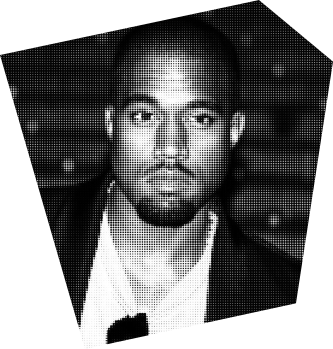
Finally, the most prolonged case of the power held
by immoral people, that covers them from ethical judgement. Kanye West – now known as Ye – demonstrates both the power and the limits of cancel culture, especially when celebrity status is involved. In 2022, Ye made headlines with brazen antisemitic remarks, openly praising Hitler and spouting racist, misogynistic rhetoric. Important to mention, that lately West changed his opinion on Hitler multiple times and projected it online, and that might happen with practically all of his statements. Major brands such as Adidas, in order to protect the company's reputation, swiftly severed ties, yet Ye retained
a substantial fanbase, raising the unsettling question about cancelling a figure that big as Kanye is.
by immoral people, that covers them from ethical judgement. Kanye West – now known as Ye – demonstrates both the power and the limits of cancel culture, especially when celebrity status is involved. In 2022, Ye made headlines with brazen antisemitic remarks, openly praising Hitler and spouting racist, misogynistic rhetoric. Important to mention, that lately West changed his opinion on Hitler multiple times and projected it online, and that might happen with practically all of his statements. Major brands such as Adidas, in order to protect the company's reputation, swiftly severed ties, yet Ye retained
a substantial fanbase, raising the unsettling question about cancelling a figure that big as Kanye is.
Kanye West arrives
at the Vanity Fair Oscar Party
at the Vanity Fair Oscar Party
The Anti-Defamation League's CEO, Jonathan Greenblatt, responded: “Here we go again. Another appalling exhibition of antisemitism, racism, misogyny… Kanye has a vast platform to disseminate his antisemitism and hatred. Words carry weight.” Despite this, Ye's influence endures, his followers often rationalizing and disregarding his actions, often justifying him for his mental disease. People tend to not take all of his actions and speeches seriously, considering Kanye's long-going bipolar. Should or should not be the mental destruction be the excuse for using power to spread hate – is an open question, and that's exactly why Kanye West, apart from his numerous scandals online, is still “alive” on the internet and allowed to influence the masses, keeping the status of a legendary musician.
Kanye West,
february 2025
february 2025
These three cases might not be the most illustrative, but all of them demonstrate the profound effects as much as dilemmas of cancel culture. On the same planet Weinstein's punishment stands as a victory for a society and social justice, while Grebenshchikov's exclusion exposes pitfalls of conflating individuals with state actions, leading to unfair treatment. Ye's repeated offences highlight both the effectiveness and limitations of cancel culture when privilege, fame and even mental condition enter the equation. Through such stories, society is forced to grapple with the double-edged nature of cancel culture: capable of deep moral transformation, but equally susceptible to error and abuse.

Cancel culture is a law force that comes from society, not a state, which makes this practice twisted and sometimes questionable. To reveal ethical ambiguities that appear with cancel culture, we should study real-life cases and figure out how society tends to cancel people and what can be
the reason for it.
the reason for it.
To simplify our study we can divide all cases in three groups:
People who got cancelled reasonably, basically
the most illustrative cases how cancel culture need
to work ideally. That people, suchas Kevin Spacey,
P. Diddy and others, got their deserved punishment motivated by voices of people, not a lawsuit.
the most illustrative cases how cancel culture need
to work ideally. That people, suchas Kevin Spacey,
P. Diddy and others, got their deserved punishment motivated by voices of people, not a lawsuit.
GROUP 1
GROUP 2
People who got cancelled because of the duality
of opinions and simply got “under attack” for
no reason. That usually appears when beliefs
of different cultures, religions and governments meet
and create a conflict of opinions.
of opinions and simply got “under attack” for
no reason. That usually appears when beliefs
of different cultures, religions and governments meet
and create a conflict of opinions.
GROUP 3
People, who logically should get cancelled for their speeches and actions, but for some reason are still active in the media – these people usually have impressive weight for the industry and a long-live reputation, which makes
the masses close their eyes on crimes made by a highly respected person.
the masses close their eyes on crimes made by a highly respected person.
FIRST CASE
The case of Harvey Weinstein took place in the rise of cancel culture and became exemplary for it. In 2017, investigative journalism exposed a decades-long pattern of sexual abuse and harrasment by Weinstein, who were one of Hollywood's most influential producers at the moment. The sheer weight of accusations, brought forth by many women from industry, led to Weinstein's conviction and even imprisonment, but the wider impact was seismic: not long after thousands of women started a MeToo Movement, which motivated the victims of sexual abuse to speak up about their experiences mainly to raise awareness.
This movement changed the cultural landscape
and, in the words of feminist legal scholar Catharine MacKinnon, “shifting gender hierarchy's tectonic plates”. The case of Weinstein practically created cancel culture in its actual form and narrativeand it exemplified when the movement becamean instrument of long-overdue justice, given to the arms of ordinary people. It also shows how the voice of the masses can force the actual lawsuit, starting from cancelling a person in the media.
and, in the words of feminist legal scholar Catharine MacKinnon, “shifting gender hierarchy's tectonic plates”. The case of Weinstein practically created cancel culture in its actual form and narrativeand it exemplified when the movement becamean instrument of long-overdue justice, given to the arms of ordinary people. It also shows how the voice of the masses can force the actual lawsuit, starting from cancelling a person in the media.
SECOND CASE
In contrast, Boris Grebenshchikov's experience with cancel culture is marked by the complexities of politics and identity, raising questions about fairness. Grebenshchikov, the leader of legendary Russian band “Aquarium”, was cancelled in home country for his anti-war stance, and subsequently shunned by some Western events simply for his nationality, even though he clearly opposed the war in question. This “double cancel” effect, as described in reports, reveals the danger when cultural sanctions fail to distinguish between the actions of individuals and the policies of states. As Grebenshchikov stated himself, “To my mind, a concert can't be ‘anti’, and neither can culture. It's impossible. There is culture, and then there is an absence of culture”
His enforced absence from the stage has become a symbol of the collateral damage cancel culture can inflict when weaponised amidst geopolitical conflicts. “People don't want to hear, think or talk about the war. They push it out of their consistence”, Grebenshchikov observed on the risks of cultural suppression. This exclusion, when driven by political motives rather than personal wrongdoing, invites scrutiny of cancel culture's ethical boundaries.
THIRD CASE
Finally, the most prolonged case of the power held by immoral people, that covers them from ethical judgement. Kanye West – now known as Ye – demonstrates both the power and the limits of cancel culture, especially when celebrity status is involved. In 2022, Ye made headlines with brazen antisemitic remarks, openly praising Hitler and spouting racist, misogynistic rhetoric. Important to mention, that lately West changed his opinion on Hitler multiple times and projected it online, and that might happen with practically all of his statements. Major brands such as Adidas, in order to protect the company's reputation, swiftly severed ties, yet Ye retained
a substantial fanbase, raising the unsettling question about cancelling a figure that big as Kanye is.
a substantial fanbase, raising the unsettling question about cancelling a figure that big as Kanye is.
The Anti-Defamation League's CEO, Jonathan Greenblatt, responded: “Here we go again. Another appalling exhibition of antisemitism, racism, misogyny… Kanye has a vast platform to disseminate his antisemitism and hatred. Words carry weight.” Despite this, Ye's influence endures, his followers often rationalizing and disregarding his actions, often justifying him for his mental disease. People tend to not take all of his actions and speeches seriously, considering Kanye's long-going bipolar. Should or should not be the mental destruction be the excuse for using power to spread hate – is an open question, and that's exactly why Kanye West, apart from his numerous scandals online, is still “alive” on the internet and allowed to influence the masses, keeping the status of a legendary musician.
These three cases might not be the most illustrative, but all of them demonstrate the profound effects as much as dilemmas of cancel culture. On the same planet Weinstein's punishment stands as a victory for a society and social justice, while Grebenshchikov's exclusion exposes pitfalls of conflating individuals with state actions, leading to unfair treatment. Ye's repeated offences highlight both the effectiveness and limitations of cancel culture when privilege, fame and even mental condition enter the equation. Through such stories, society is forced to grapple with the double-edged nature of cancel culture: capable of deep moral transformation, but equally susceptible to error and abuse.
Harvey Winstein in court, april 22 2025
Harvey Weinstein
at the 2015 Oscars
at the 2015 Oscars
Boris Grebenshchikov
performs in 2016
performs in 2016
Boris Grebenshchikov
performs in Vilnius
performs in Vilnius
Kanye West at the Vanity Fair Oscar Party
Kanye West,
february 2025
february 2025


So, what did we learn about cancel culture?
It's a powerful tool that can do both good and bad. It helps ordinary people hold the powerful accountable when the system fails. But it can also turn into an online mob that ruins lives over small mistakes.
It's a powerful tool that can do both good and bad. It helps ordinary people hold the powerful accountable when the system fails. But it can also turn into an online mob that ruins lives over small mistakes.
We've seen real people get destroyed for single tweets or jokes.
The question is: do we want to live in a world where everyone is afraid
to speak up? Or can we find a way to demand accountability without creating a culture of fear?
The question is: do we want to live in a world where everyone is afraid
to speak up? Or can we find a way to demand accountability without creating a culture of fear?
The big difference is how it's used:
In the West, it's like
a fight among citizens about values
and free speech
a fight among citizens about values
and free speech
THE WEST
RUSSIA
THE WEST
RUSSIA
THE WEST
RUSSIA
In Russia, it's more like a weapon the government uses
to control people
to control people
The solution isn't to stop
fighting for justice, but
to remember that real change comes from dialogue and understanding, not
from destroying
people online.
fighting for justice, but
to remember that real change comes from dialogue and understanding, not
from destroying
people online.

So, what did we learn about cancel culture?
It's a powerful tool that can do both good and bad. It helps ordinary people hold the powerful accountable when the system fails. But it can also turn into an online mob that ruins lives over small mistakes.
It's a powerful tool that can do both good and bad. It helps ordinary people hold the powerful accountable when the system fails. But it can also turn into an online mob that ruins lives over small mistakes.
The big difference is how it's used:
THE WEST
THE WEST
THE WEST
In the West, it's like
a fight among citizens
about values
and free speech
a fight among citizens
about values
and free speech
RUSSIA
RUSSIA
RUSSIA
In Russia, it's more like a weapon the government uses
to control people
to control people
We've seen real people get destroyed for single tweets
or jokes. The question is: do we want to live in a world where everyone is afraid to speak up? Or can we find
a way to demand accountability without creating
a culture of fear?
or jokes. The question is: do we want to live in a world where everyone is afraid to speak up? Or can we find
a way to demand accountability without creating
a culture of fear?

The solution isn't to stop
fighting for justice, but
to remember that real change comes from dialogue
and understanding,
not from destroying
people online.
fighting for justice, but
to remember that real change comes from dialogue
and understanding,
not from destroying
people online.

